School catchments on the Gold Coast, explained
If you are renting or buying on the Gold Coast with school-age kids — or kids who will be school-age before you move again — the word “catchment” starts turning up in every conversation. Here is what it actually means, and how to get a straight answer for a specific address.
What a catchment is
A catchment is the enrolment boundary of a Queensland state school, set by Education Queensland. Every state school with a catchment must enrol students who live inside it — that is the guarantee the boundary exists to provide. Live inside the line and the school cannot turn your child away for lack of space; live outside it and enrolment is at the school's discretion, subject to capacity.
A few things follow from that which surprise people:
- Catchments apply to state schools only. Non-government schools set their own enrolment policies and take students from anywhere.
- One address usually sits in several catchments at once — a primary catchment and secondary catchments are separate layers, so a single house is typically zoned to more than one school.
- Boundaries follow enrolment planning, not suburb lines. A street can be zoned to a school a suburb or two away while the school around the corner serves a different area. Assuming your catchment from your suburb name is the classic mistake.
Checking an address
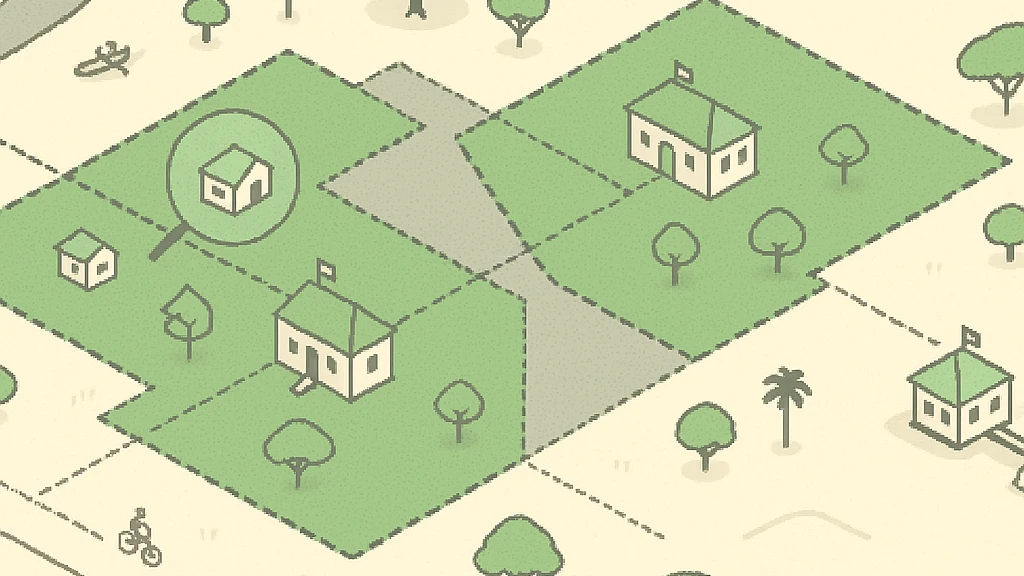
Our school catchments page draws the catchment boundaries over the actual buildings on the isometric map, so you can see where a line runs down a street rather than squinting at a PDF. From there you can look up a specific address and get every catchment it falls inside — which is the only answer that matters, because a boundary can genuinely run between two neighbours.
A boundary is not a ranking
A catchment tells you which school must take your child. It tells you nothing about whether that school is the right one. Real estate listings love to treat a catchment name as a badge of quality, but the boundary itself carries no judgement — it is an enrolment planning tool, drawn and redrawn to balance student numbers against capacity. If school quality matters to your decision, visit the schools, talk to them, and form your own view. The map can tell you where the line is; it cannot tell you which side of it you want to be on.
Where the data comes from
The catchment boundaries we draw come from the Department of Education's published catchment data. Boundaries do change as enrolment plans are revised, so treat any map — ours included — as indicative, and confirm with the department or the school itself before you enrol, sign a lease or buy a house on the strength of a line on a map.